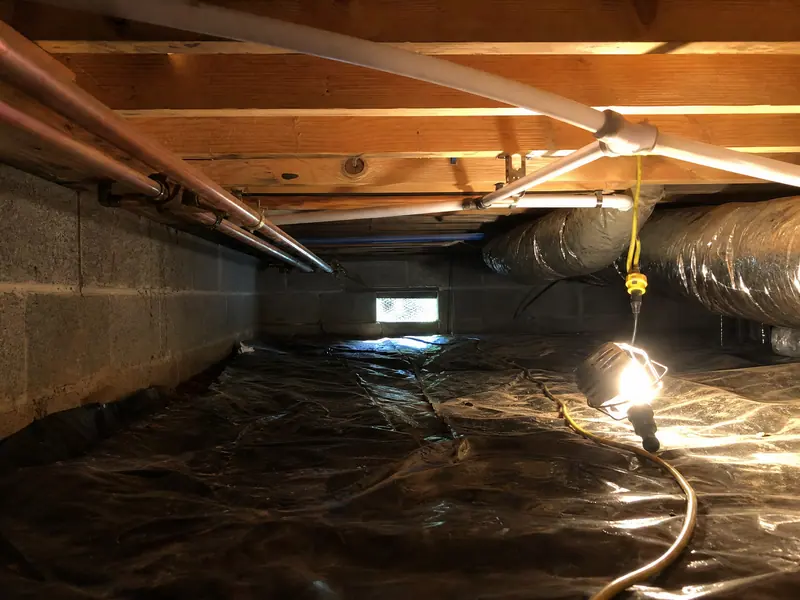
Why do crawlspace pipes freeze first?
They sit in the one part of the house that is neither heated nor buried. The Red Cross lists supply pipes in unheated interior areas, crawl spaces among them, as the usual trouble spots, along with pipes on poorly insulated outside walls (American Red Cross, archived copy). In a house built over a crawlspace, the supply lines often run through that space, a few feet above bare ground and close to the vents.
Water expands as it turns to ice, and the Red Cross notes that this pressure can split a metal or plastic pipe whatever its strength. The break often shows only after the thaw, when water starts to flow again.
How cold does a Clarksville winter night get?
January lows average 27.8°F at the Clarksville WWTP station, the coldest month of the year in NOAA's 1991–2020 normals (NOAA NCEI monthly normals). December and February average lows of 31.1°F and 30.6°F, both just under freezing. A crawlspace open to that air through vents or gaps follows it down over a long night.
An average low hides the nights that do the damage. Those are the hard-cold ones, shown next.
Which nights put crawlspace lines at real risk?
The nights at 20°F or colder, which come about 16 times a year. January averages 7.0 of them, February 4.1 and December 3.7, with a few stragglers in November and March. A long run of those nights, especially with wind, is when a line near a vent or the rim joist is most likely to freeze.
Across town the counts barely change, so a house near the airport and one near the river face much the same winter. The full year of freezing nights is on our freeze nights page.
How do you protect pipes in a crawlspace?
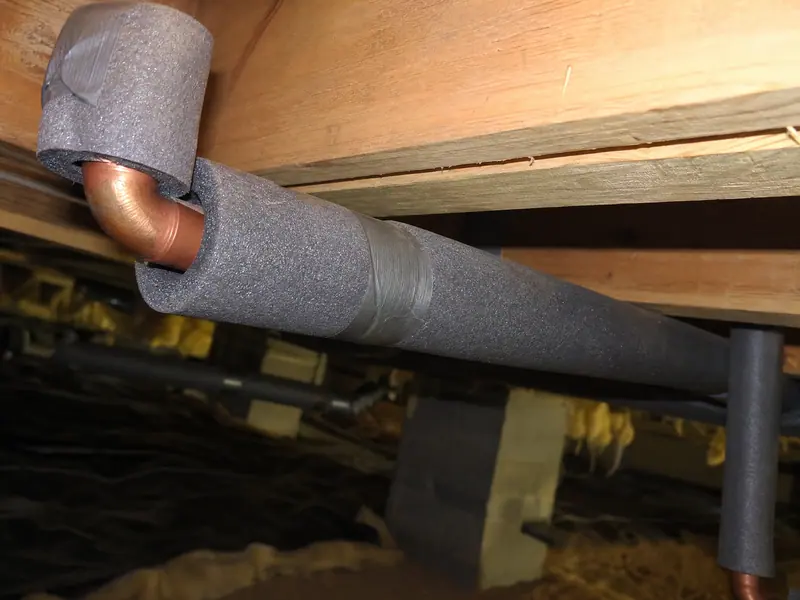
Insulate them and keep the space warmer. The Red Cross recommends adding insulation to crawl spaces and wrapping both the hot and the cold lines in unheated areas. It names pipe sleeves and UL-listed heat tape or heat cable as options; any heat cable should be installed and plugged in exactly as its maker's instructions say.
- Wrap every exposed run, paying most attention to lines near vents, the access door and the rim joist.
- Look for where the service line comes up through the foundation, which the Red Cross singles out as a common freeze point.
- Seal gaps that let wind blow straight across the pipes.
- Drip the faucet that the crawlspace line feeds on hard-freeze nights, and always on nights at 20°F or below; exposed crawlspace lines can freeze above 20°F.
Who is responsible for the pipe under the house?
You are. CGW's job stops at the meter: past the yoke the meter sits in, the line to the building and all the plumbing inside are the property owner's to keep up (CGW FAQ). CGW's public service-line map lists 3,252 customer-side lines marked "galvanized requiring replacement"; our lead service lines page shows how to look up your address.
Replacing or rerouting pipe is permit work. Within city limits a plumbing permit has to come through a licensed contractor, not the homeowner (City of Clarksville Building & Codes). In the unincorporated county the rules differ, so ask the permit office which applies before any pipe is cut. Details are on our permits and licenses page.
What if a crawlspace pipe freezes or bursts?
If it has burst, shut the main water valve first. For a frozen section you can reach safely, use the gentle heat the Red Cross approves, such as a hair dryer or a heating pad wrapped around the line, or hot wet towels, and leave the faucet open. Use an electric tool only if the crawlspace is dry, plug it into a GFCI-protected outlet, and never stand on wet ground; if water has pooled, stay out until the power is off. If the frozen spot is out of reach or will not thaw, call a licensed plumber.
A burst that ran for hours before anyone noticed will show on the meter and the next bill. Our leaks on the meter page covers the reading.
Behind these numbers
Lows and night counts are NOAA's thirty-year averages for the treatment-plant station, with the airport as a check, as published on 6 Nov 2026. Neither station measures a crawlspace, and no public record shows how cold crawlspaces in Clarksville actually get, so read the outdoor numbers as the pressure on the space rather than its own temperature. The galvanized count is our tally of CGW's public map on 6 Nov 2026, not a figure CGW publishes.
Questions people ask
Should crawlspace vents be closed in winter?
We found no Clarksville or Tennessee agency guidance on vent settings. The Red Cross advice is to insulate the space and the pipes and to seal drafts that reach them; ask a licensed contractor about vents in your house.
Is newspaper enough to protect a crawlspace pipe?
The Red Cross says even a quarter inch of newspaper gives some protection where hard freezes are short and infrequent. For a crawlspace that sees 20°F nights, purpose-made pipe insulation is the steadier choice.
Do hot water lines in a crawlspace need insulation too?
Yes. The Red Cross says both hot and cold lines in unheated areas should be insulated, since a hot line sits full of standing water overnight.
Can a space heater go in a crawlspace?
The Red Cross allows a portable space heater for thawing only when it is kept away from anything that can burn. A crawlspace is tight and often full of dry wood and insulation, so call a licensed plumber rather than run one there.
Sources
- NOAA NCEI — U.S. Climate Normals 1991–2020, monthly, station USC00401790 · monthly normal lows, freezing nights and nights at or below 20°F · checked 6 Nov 2026
- NOAA NCEI — U.S. Climate Normals 1991–2020, monthly, station USW00003894 (Outlaw Field) · airport freezing-night counts for comparison · checked 6 Nov 2026
- American Red Cross — Preventing & Thawing Frozen Pipes · crawl spaces as risk areas, insulation, pipe sleeves, heat tape, thawing · archived copy of 6 Nov 2026, checked 6 Nov 2026
- Clarksville Gas & Water — Water Pressure FAQ · owner maintains the pipe from the meter yoke to the building · checked 6 Nov 2026
- CGW — Service Material Survey public layer · 3,252 customer-side galvanized lines, our count · checked 6 Nov 2026
- City of Clarksville Building & Codes — Permitting · plumbing permits only through licensed contractors · checked 6 Nov 2026
- FEMA Ready.gov — Floods · electrocution risk in standing water · checked 6 Nov 2026