
What temperature should a water heater be set to?
For most homes, 120°F. The Department of Energy notes that some makers ship thermostats at 140°F but that most households only need 120°F, which also slows mineral buildup and corrosion in the heater and pipes (DOE Energy Saver, archived copy of 22 May 2026). The electric heater manual on A. O. Smith's site says its thermostats leave the factory at about 120°F to reduce the risk of scalding (electric water heater manual). A dial marked in words rather than degrees needs a thermometer check at the tap, covered below.
How fast can hot water scald?
Fast, once the water passes 130°F. The Consumer Product Safety Commission says most adults get a third-degree burn from two seconds at 150°F, six seconds at 140°F, thirty seconds at 130°F and about five minutes at 120°F (CPSC, Avoiding Tap Water Scalds). The maker's manual singles out children, older people and people with disabilities as most at risk, so the 120°F setting matters most in homes where they live.
The maker's manual prints its own burn table, with slightly different times at a few settings. Both sources agree on the shape of the curve.
| Water temperature | Time to a serious burn |
|---|---|
| 120°F | More than 5 minutes |
| 125°F | 1½ to 2 minutes |
| 130°F | About 30 seconds |
| 140°F | Less than 5 seconds |
| 150°F | About 1½ seconds |
The same manual warns that a setting is not a ceiling. Repeated short draws can leave layers in the tank up to thirty degrees hotter than the dial, and a failed thermostat can overheat the water. Mixing valves at the taps limit what reaches the skin even when the tank runs hot.
Does turning the water heater down save money?
Yes, though the size depends on the house. Water heating is about 18% of a home's energy use by DOE's count (DOE Energy Saver, archived copy of 31 May 2026). DOE also estimates that a tank held at 140°F can waste $36 to $61 a year in standby heat alone, with further savings from heating less water for showers and laundry that it says may exceed $400. Those are national figures; at Clarksville's electric rates the dollars would be smaller. We found no confirmed per-degree saving on any current DOE page, so we do not quote one. For a yearly baseline at local rates, see the running cost page.
When might a higher setting make sense?
DOE names two cases. A dishwasher without its own booster heater may need 130°F to 140°F for best cleaning, and someone with a suppressed immune system or chronic respiratory disease may consider keeping the tank at 140°F. The electric manual adds that 140°F can curb the bacteria behind a "rotten egg" smell in the hot water itself. A rotten-egg smell in the air may be gas: leave now, keep the door open behind you, and once outdoors call 911, then CGW's gas emergency line. In every case both sources pair the higher setting with thermostatic mixing valves at the taps used for washing and bathing, so the tank can run hot while the shower does not.
How do you check the temperature at the tap?
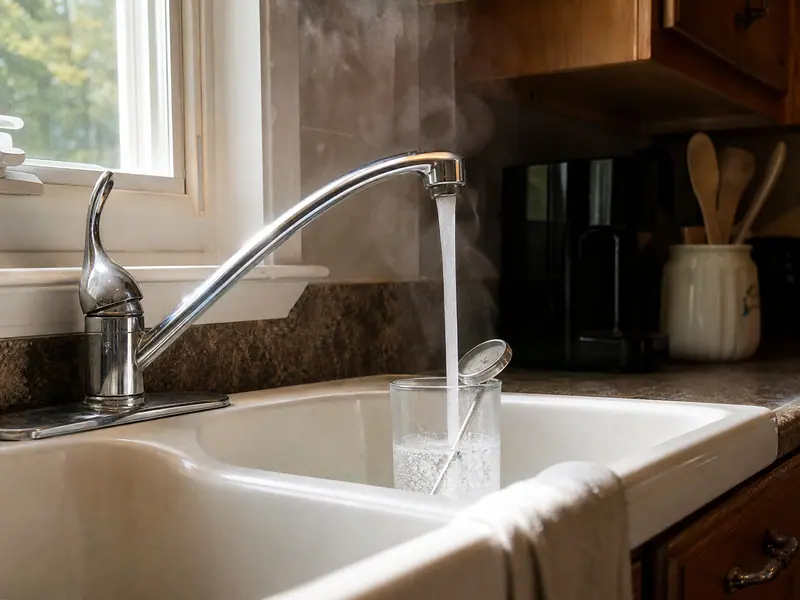
Run hot water at the tap farthest from the heater for a few minutes, then hold a cooking thermometer in the stream. The DOE video below shows the routine: read the temperature, turn the thermostat down toward 120°F, and re-check after a couple of hours. On an electric heater, switch its breaker off before you open any access panel, and leave it off until the panels are back on; the video does not say this step.
How is the thermostat adjusted on an electric water heater?
Only as the heater's own manual describes. The A. O. Smith manual's steps on page 15 begin with the circuit breaker turned off and a circuit tester used to confirm the power is dead. Then the upper and lower access panels come off, the insulation folds back, and each dial turns: clockwise for hotter, counter-clockwise for cooler. Both thermostats should match, with the upper never set higher than the lower. Insulation and panels go back on before the breaker is switched on again, and the water may take a few hours to reach the new setting.
What about a gas water heater's temperature?
On a gas tank the temperature knob is part of the gas control, so we give no steps for it. Ask a licensed plumber to change the setting, and leave the pilot, burner and gas valve to a professional; a thermometer at the tap afterwards tells you where it landed. Smell gas? Don't flip a switch, use a phone or strike a flame indoors. Get out, leave the door open, and from the yard or a neighbor's house call 911 and CGW's gas emergency line. When a carbon monoxide alarm sounds, everyone heads outside to fresh air first, and the 911 call is made from there.
Behind these numbers
The temperature advice rests on two federal agencies and one maker's manual. DOE's live Energy Saver pages returned errors on 6 November 2026, so we used the archived copy of 22 May 2026; the CPSC leaflet dates from 2012. Burn times differ a little between CPSC and the manual, and we show both rather than blend them. Dollar savings are DOE's national estimates and have not been repriced at Clarksville rates. Hard water and tank sediment, which a hotter tank can speed up, are covered on the water hardness and flushing pages.
Questions people ask
Is 120°F hot enough to kill bacteria in the tank?
DOE says there is a very slight risk of legionella bacteria at 120°F but still calls it safe for most people. Those with weakened immunity or chronic respiratory disease may choose 140°F with mixing valves at the taps.
Why is my hot water hotter than the dial says?
The electric manual lists several reasons: water stacking in layers after many short draws, a faulty thermostat, a hot room around the tank, or pre-heated supply water. A thermometer at the tap tells you what actually comes out.
Should the water heater go off when the house is empty?
DOE's video suggests switching an electric heater off at the breaker while you are away. If the tank was drained while you were gone, refill it completely before the breaker goes back on.
Does a lower setting give less hot water?
The electric manual lists more hot water capacity among the reasons some owners choose a higher setting. It also notes that setting the upper thermostat above the lower one can cause a shortage of usable hot water.
Do landlords or codes set a hot water temperature?
The electric manual says some local codes or state laws require a certain temperature at the tap. Check with the City of Clarksville or Montgomery County codes office before changing a rental's setting; the permits page lists both offices.
Sources
- DOE Energy Saver — Lower Water Heating Temperature, archived copy of 22 May 2026 · 120°F advice, $36–$61 standby, dishwasher and health cases · checked 6 Nov 2026
- CPSC — Avoiding Tap Water Scalds, Publication 5098 · burn times at 120–150°F · checked 6 Nov 2026
- Residential electric water heater manual, A. O. Smith domain · factory setting, burn table (p.4), thermostat steps (p.15) · checked 6 Nov 2026
- DOE Energy Saver — Water Heating, archived copy of 31 May 2026 · water heating as about 18% of home energy use · checked 6 Nov 2026
- U.S. Department of Energy — Lowering Your Water Heater Temperature (video) · tap-thermometer routine and breaker-off-when-away tip · checked 6 Nov 2026