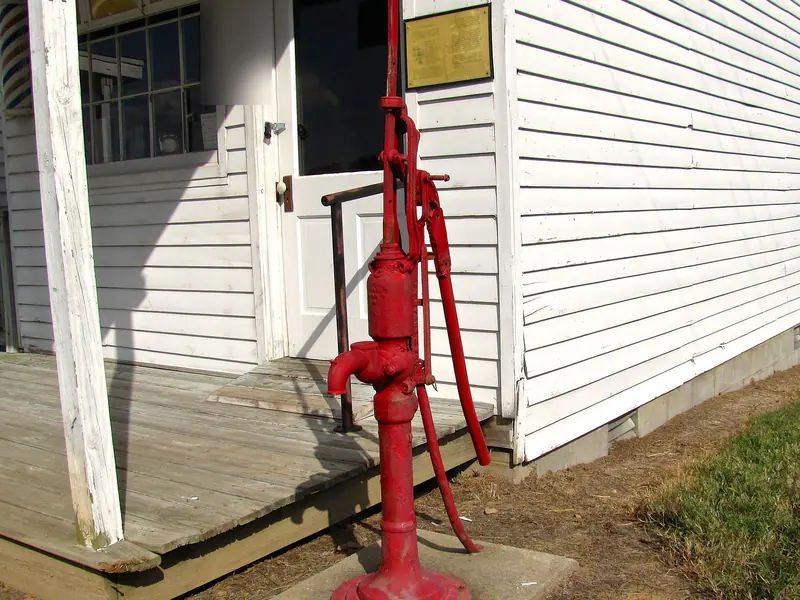
A house on a private well sits outside everything in Clarksville's annual water report. The EPA's public water rules do not reach private wells, as the CDC's well testing guidance points out, and Tennessee adds no testing rule of its own. The TDEC well water page says plainly that the state has no requirements for sampling private supplies. Testing, upkeep and records fall to the household.
What should a yearly well test cover?
Four things, according to both the CDC and the EPA: total coliform bacteria, nitrate, total dissolved solids and pH. TDEC's own advice focuses on bacteria, the one it strongly recommends every year. The limits below are the federal public-water numbers, used here as a yardstick because a private well has none of its own.
| Test | Why it matters | Yardstick |
|---|---|---|
| Total coliform bacteria | a sign that surface water or sewage may be reaching the well | federal goal of zero |
| Nitrate | fertilizer, septic and animal waste; most serious for babies under six months | 10 mg/L as nitrogen |
| Total dissolved solids | the overall mineral load; affects taste and scale | no number given by CDC |
| pH | low or high pH can corrode pipes and release metals | 6.5 to 8.5 (secondary) |
Ask the county health department or TDEC about other local concerns before paying for a wide panel, since the CDC notes such tests can be expensive. Hardness is a common add-on; our hardness page explains the scale used for city water.
Who tests well water in Montgomery County?
A state-certified laboratory. TDEC points well owners to its Laboratory Certification Program, which publishes lists of private labs certified for drinking water. The Montgomery County Health Department's page lists no well-testing service, so check with the lab directly on bottles, holding times and how fast the sample must arrive. If a lender requires a test before a sale, TDEC says to ask the lender which parameters it wants.
The Maine CDC video shows how to fill sample bottles at a kitchen tap. Its emphasis on arsenic and uranium reflects Maine's rock; in Tennessee, follow the bottle instructions from your certified lab and TDEC's yearly bacteria advice.
When should a well be tested between yearly checks?
Right away after anything that could let surface water in. The EPA's well owner guidance lists flooding, land disturbance or new construction nearby, any repair to the well system, and a change in taste, odor or color. The CDC adds a pregnancy in the household or a child coming to live there. Clarksville's rain is spread across the year, so there is no dry season to wait out.
EPA notes that runoff from rain can wash germs into a well or seep down to it. A test after a wet spell, as well as the routine yearly one, gives a fairer picture.
Why do sinkholes matter for a well here?
Montgomery County sits on the Highland Rim, which the USGS describes as underlain by Mississippian limestone, with sinkholes common where the purest limestone crops out. In Clarksville the USGS even keeps a monitoring site at a sinkhole that takes urban storm runoff straight into the ground. EPA's advice for domestic wells includes keeping contaminants away from sinkholes as well as from the well itself; our sinkholes and karst page covers the ground in more detail.
How far must a well be from a septic system?
At least 50 feet from a septic tank or drain field, under TDEC's minimum separation distances for new wells. Larger waste sources need more room, and the state adds a 20-foot chemical-free radius around the wellhead. Our septic page covers permits for the tank side.
TDEC also asks that casing stand at least 6 inches above ground, 2 feet in flood-prone spots, and that the ground slope away from the well.
Who works on a well in Tennessee?
Licensed contractors. The Tennessee Water Well Act of 1963 requires anyone drilling a well, or installing a pump or treatment device on one, to hold a state license. The driller files a well report with TDEC, and owners should ask for a copy; a well taken out of service must be closed by a licensed driller. TDEC also says the casing should never be cut off by the owner.
If a test comes back positive for bacteria, TDEC's steps are to disinfect the well and retest, and to consider permanent treatment such as a chlorinator or UV light if bacteria return. TDEC's standards have the driller or pump installer disinfect after any service, and the EPA's limit table explains what a nitrate result over 10 mg/L means for infants. High water on the river side is on our Cumberland River page.
Behind these numbers
This page rests on TDEC's well water page, CDC and EPA well guidance, EPA's drinking water limits and NOAA's Clarksville rain normals, all checked on 6 Nov 2026. It gives no count of wells in the county or typical local results, because no primary source we reached publishes them. TDEC's well manual and its water-wells page refused our requests, so details found only there are missing.
Questions people ask
Does a Tennessee home sale require a well test?
State law does not, but lenders often do. TDEC suggests asking the lender which tests it needs, then using a certified drinking-water lab.
Is the county health department able to test well water?
Its page lists no well-testing service. A lab on TDEC's certified list is the usual route, and TDEC field offices can help with questions and driller's reports.
What do coliform bacteria in a well sample mean?
Coliforms are indicators: most do not cause illness, but their presence suggests a path for germs from soil, surface water or sewage. A positive result means disinfecting and retesting, per TDEC.
How deep are wells in Middle Tennessee?
Depth varies by site. EPA describes dug wells at about 10 to 30 feet, driven wells at 30 to 50, and drilled wells that can go far deeper with lower contamination risk. TDEC says most Middle Tennessee wells need steel casing.
Can a house switch from a well to city water?
That depends on whether a CGW main reaches the road. CGW serves the city and parts of the county; the utility can say whether service is available at an address.
Sources
- TDEC Division of Water Resources — Well Water · no state testing rule, yearly bacteria advice, setbacks, casing, licensing, disinfection, lender question · checked 6 Nov 2026
- CDC — Guidelines for Testing Well Water (1 July 2024) · four yearly tests, certified labs, when to retest · checked 6 Nov 2026
- US EPA — Protect Your Home's Water · when to test, sinkholes, flood steps for wells · checked 6 Nov 2026
- US EPA — Learn About Private Water Wells · dug, driven and drilled well depths · checked 6 Nov 2026
- US EPA — National Primary Drinking Water Regulations · nitrate 10 mg/L, coliform goal · checked 6 Nov 2026
- USGS — Karst regions of Tennessee, WRIR 97-4097 · Highland Rim limestone and sinkholes · checked 6 Nov 2026
- NOAA NCEI — 1991–2020 monthly normals, Clarksville WWTP · monthly precipitation · checked 6 Nov 2026
- Maine CDC — How to Test Your Well Water (video) · sampling at the tap · checked 6 Nov 2026