
Why is an empty house at more risk in winter?
Nobody is there to notice a cold room, a slow faucet or a wet floor. A pipe that freezes on a January night in an occupied house is usually found the next morning; in an empty house it can thaw, split and run for days. The months from November through March hold 75.7 of Clarksville's 78.4 average freezing nights, by our addition of NOAA's monthly normals (NOAA NCEI monthly normals).
That is why the line in the lead matters. The full freeze calendar, with first and last freeze dates, is on our freeze nights page.
How warm should you keep an empty house?
No lower than 55°F. The Red Cross says that if you will be away in cold weather, leave the heat on and set it to at least 55°F (American Red Cross, archived copy). It also says to open the cabinet doors under kitchen and bathroom sinks so warmer air reaches the plumbing, which matters more when no one is opening them each day.
How hard the furnace or heat pump works depends on the month. Heating degree days, a standard measure of heating demand, peak in January.
Keep the utility accounts active and paid while you are gone. A heat pump or gas furnace that loses power or fuel leaves the pipes with no protection at all. Our gas and electric rates page shows what CGW, CDE Lightband and CEMC charge.
Should you shut off the water before you leave?
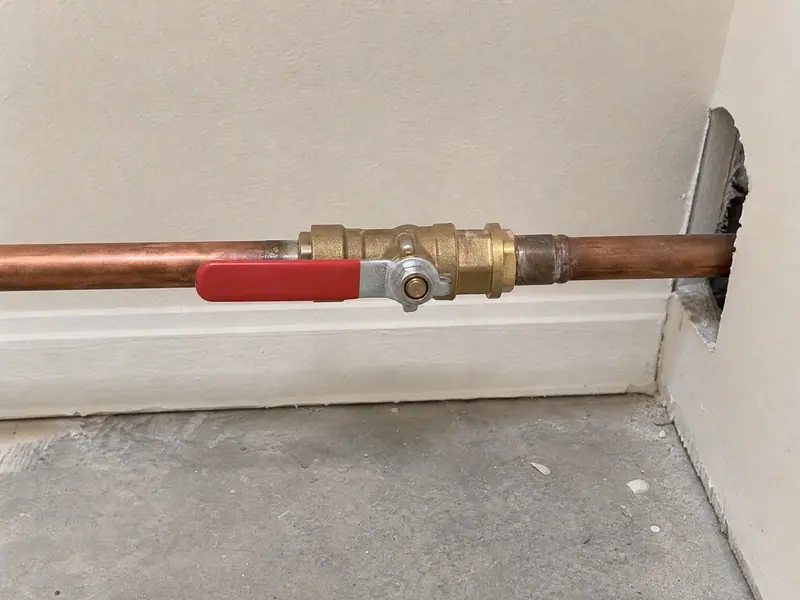
For any absence longer than a few days, closing the main valve limits what a split pipe can release. With the main shut, a broken line can only drain the water already in it. Find the valve before winter, try it, and tag it so a neighbor or house-sitter can find it fast.
Then open a cold faucet on the bottom floor to relieve pressure in the lines. Draining a whole house, blowing out lines or adding antifreeze is a job for a licensed plumber; the Red Cross, writing about pool and sprinkler lines, warns against antifreeze unless someone qualified directs it.
If the main valve is stiff, corroded or will not close, have a licensed plumber replace it before you leave.
Who is responsible for the pipe if it breaks?
The owner. CGW puts the line beyond the meter yoke, right up to the building, in the property owner's hands (CGW FAQ). A leak on that stretch, or anywhere inside, is the owner's to find and fix, and the water it loses passes through the meter.
What does an empty house cost on the CGW bill?
At least $30.28 a month inside the city, by our arithmetic from CGW's rate schedule effective July 1, 2024. Water carries a $9.00 meter charge even at zero use, and sewer has a $5.00 environmental compliance fee plus a minimum bill based on 2,000 gallons at $8.14 per 1,000 (CGW Water Rate Schedule A).
A leak changes that quickly. EPA puts a toilet leak at roughly 200 gallons every day (EPA WaterSense Kids); over a two-week trip that is 2,800 gallons, about $35 at inside usage rates, by our arithmetic. Every rate line is broken out on the CGW bill page.
How do you check for a leak when you get back?
Read the meter as you leave and again when you return. With the main closed, the dial should not move at all. If you left the water on, EPA's test is to read the meter before and after a two-hour stretch with no water in use; any change suggests a leak (EPA Fix a Leak Week). Our leaks on the meter page explains the low-flow dial.
When you reopen the main, do it slowly and walk the house and crawlspace for drips. If a move or deployment leaves the house empty for months, ask a neighbor or house-sitter to check the heat and look for water at least weekly, and leave them a note of where the main valve is.
Behind these numbers
Freeze counts and heating degree days use NOAA's 1991–2020 averages for the city's treatment-plant gauge; the bill floor is our arithmetic from CGW's July 1, 2024 schedule, which CGW still listed as current on 6 Nov 2026. Taxes, gas and electric charges are left out of the $30.28. We did not look at insurance terms for vacant homes, landlord duties for rented houses, or any rules that apply to military households, so check those with your insurer, lease or command.
Questions people ask
Is 55°F warm enough for pipes in outside walls?
It is the Red Cross minimum for the thermostat, not a guarantee for every wall. On nights near 20°F, leaving sink cabinets open and the main valve closed adds a margin.
Does the water heater need draining before a long trip?
Not as a matter of course. If you do, an electric heater's breaker stays off until the tank is refilled, and a gas heater is left to CGW or a licensed plumber.
Will CGW stop billing if nobody uses water?
No. The water meter charge, the environmental compliance fee and the 2,000-gallon sewer minimum still apply, about $30.28 a month inside the city at July 1, 2024 rates.
What about outdoor spigots on an empty house?
Close the indoor valve that feeds each one, open the spigot outside to drain it and leave it open. Remove and store the hoses.
Does CGW need to know the house will be empty?
We found no CGW rule that asks for notice. If you plan to stop service entirely, CGW's fee page lists a $100 reactivation charge during business hours, so ask CGW before you close an account.
Sources
- NOAA NCEI — U.S. Climate Normals 1991–2020, monthly, station USC00401790 · freezing nights by month and heating degree days · checked 6 Nov 2026
- American Red Cross — Preventing & Thawing Frozen Pipes · 55°F when away, cabinet doors, hose bibs, antifreeze warning · archived copy of 6 Nov 2026, checked 6 Nov 2026
- Clarksville Gas & Water — Water Rate Schedule A · meter charge, sewer rate and minimum, compliance fee, effective July 1, 2024 · checked 6 Nov 2026
- Clarksville Gas & Water — Water Pressure FAQ · owner maintains the pipe from the meter yoke to the building · checked 6 Nov 2026
- Clarksville Gas & Water — Fees, Penalties & Deposits · reactivation charge · checked 6 Nov 2026
- EPA WaterSense — Fix a Leak Week · two-hour meter test · checked 6 Nov 2026
- EPA WaterSense — WaterSense Kids · leaking toilet, about 200 gallons a day · checked 6 Nov 2026
- A. O. Smith — Residential Electric Water Heater Use & Care Guide · breaker off until the tank is full again, pp. 20–21 · checked 6 Nov 2026