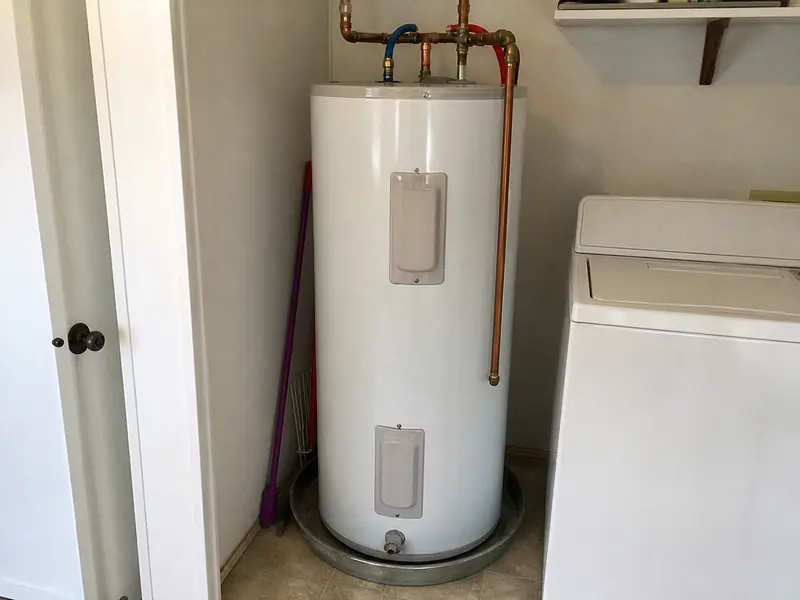
How much does an electric water heater cost to run in Clarksville?
About $388 a year in energy on CDE Lightband, and about $361 on Cumberland Electric Membership Corporation (CEMC), for a 50-gallon electric tank that just meets the federal efficiency floor. Both are our arithmetic: 3,528 kWh a year times CDE's November 2026 energy rate of $0.11010 per kWh (CDE Lightband rates), or CEMC's October 2026 energy plus fuel charge of $0.10239 per kWh (CEMC rate schedule). Fixed monthly charges are left out, since they are paid whatever heats the water. Check which utility bills you; it depends on the address.
Where does the 3,528 kWh figure come from?
It comes from the federal test that every new water heater is rated on. The Department of Energy procedure assumes a "medium" household draws 55 gallons of hot water a day and heats it 67°F, then divides by the heater's uniform energy factor, or UEF (10 CFR 430, Appendix E). For a 50-gallon electric tank the minimum UEF allowed is 0.9207, and for a 50-gallon gas tank 0.5633 (10 CFR 430.32). Plugging those in gives 3,528 kWh for the electric tank and about 197 therms for the gas one.
As a check, the FTC's EnergyGuide label rule lists $494 a year as the top of the cost range for medium electric heaters, priced at 14¢ per kWh (16 CFR Part 305). At that price, $494 is 3,529 kWh, one kilowatt-hour from our figure.
| Heater, 50 gallons | Efficiency used (UEF) | Energy a year |
|---|---|---|
| Electric tank, federal minimum | 0.9207 | 3,528 kWh |
| Gas tank, federal minimum | 0.5633 | 197 therms, about 189 CCF |
| Heat pump, ENERGY STAR floor | 3.30 | 984 kWh |
What does a gas tank cost to run on CGW gas?
About $98 a year at the rate Clarksville Gas & Water (CGW) set on 9 October 2026. CGW's meter reads in hundreds of cubic feet (CCF), and therms never appear on the bill. Using the federal label table's 1,039 Btu per cubic foot, 197 therms is about 189 CCF, or roughly 16 CCF a month. Inside the city each CCF carries a $0.140 usage charge plus a $0.3783 commodity charge (CGW gas rates, 9 Oct 2026), so 189.4 × $0.5183 comes to $98.15. Outside the city, the per-CCF charges match.
Why does the gas figure move month to month?
The commodity part of CGW's rate is reset about once a month to follow the price CGW pays for gas. Across the twelve monthly resets between November 2025 and October 2026, the low was $0.2959 per CCF and the high $0.7279.
Run the same 189 CCF through each end of that range and the gas tank's year swings from about $83 to about $164. The plain average of the twelve commodity values, $0.4288, gives about $108.
Does the gas meter charge change the comparison?
It can. CGW's inside-city meter charge is $15.00 a month, $180 a year. If the water heater is the only gas appliance in the house, that charge belongs to the heater, and the gas tank's year rises to about $278, still under the electric tank on either power company. If gas also runs the furnace or the range, the meter charge is paid anyway and the $98 figure is the fair one. Our gas and electric rates page shows how both bills are built.
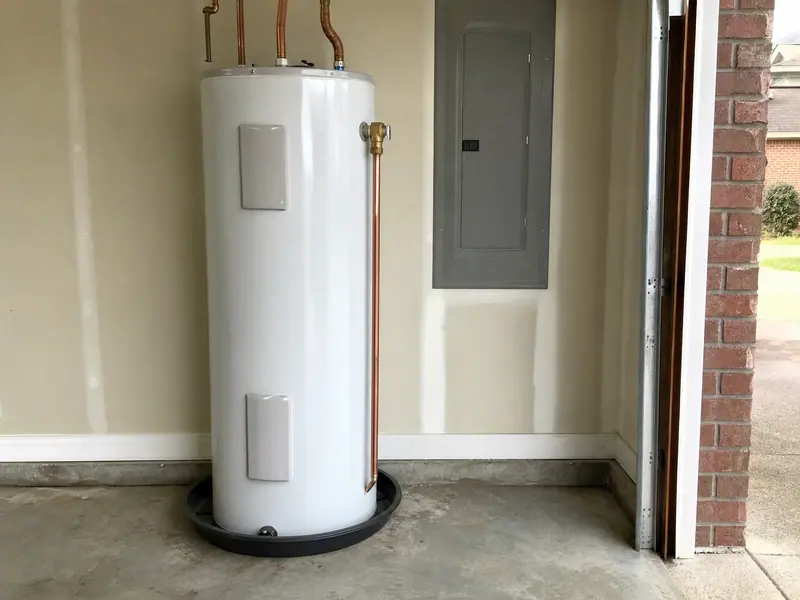
How does a heat pump water heater compare?
A heat pump water heater at the ENERGY STAR floor of UEF 3.30 needs about 984 kWh on the same test pattern, about $108 a year on CDE by our arithmetic. ENERGY STAR's own estimate, built on different household assumptions, is a saving of about 3,760 kWh a year for a family of four (ENERGY STAR). The heat pump water heater page covers the TVA EnergyRight discount and the space these units need.
What should you check on your own heater?
Start with the yellow EnergyGuide label or the data plate. The label's yearly cost is priced at national averages, so redo it with your own rate: kWh a year times your utility's per-kWh charge, or therms times about 0.96 to get CCF. Two settings change real use. A thermostat set above 120°F costs more, as the water heater temperature page explains, and sediment on electric elements is a reason the maker calls for regular flushing. The heater shelf gathers the other numbers.
Behind these numbers
These figures rest on the federal test pattern, not on metered Clarksville homes. A household that draws more or less than 55 gallons of hot water a day will land higher or lower. We checked the federal rule text, the CDE, CEMC and CGW rate sheets and the ENERGY STAR page on 6 November 2026. CEMC's rate changes with the season, and only its October 2026 schedule went into these sums. Taxes and fixed monthly charges are excluded throughout. CGW does not publish the heat content of its gas, so the conversion to CCF uses the federal label table's figure.
Questions people ask
Is a gas water heater always cheaper to run than a standard electric tank in Clarksville?
On energy alone, yes, at every CGW commodity charge from the past year. A heat pump model changes the picture: at the ENERGY STAR floor it runs about $108 a year on CDE by our arithmetic, about level with gas at the 12-month average (about $108) and below gas at the February 2026 peak (about $164). The gap narrows if the heater is your only gas appliance, because the $15 monthly meter charge then counts against it. Purchase and installation costs are not part of these figures.
Why use the federal minimum rather than my exact model?
The minimum is the one efficiency every new 50-gallon tank must meet, so it makes a fair common yardstick. Your model's UEF is printed on its label; divide 11,083,006 Btu by that number, then by 3,412 for kWh on an electric tank, to redo the sum.
Do the CDE and CEMC figures include the customer charge?
No. The $30.50 CDE customer charge, the grid access charge and CEMC's $39.00 base charge are paid whatever heats the water, so we left them out of the heater's share.
What if my heater has a first-hour rating over 75 gallons?
Then the federal test uses the high pattern of 84 gallons a day instead of 55, about half again as much hot water, so expect a larger yearly figure than the ones here.
Does propane change the picture?
Propane is sold by private suppliers at their own prices, and we found no published local rate to work from. The label rule's propane range for medium heaters runs well above its natural gas range.
Sources
- eCFR — 10 CFR Part 430, Appendix E, section 6.3.9 · annual energy formula and the 55-gallon medium pattern · checked 6 Nov 2026
- eCFR — 10 CFR 430.32(d), water heater standards · minimum UEF for electric and gas storage tanks · checked 6 Nov 2026
- eCFR — 16 CFR Part 305, Appendices D1, D2 and K1 (FTC EnergyGuide rule) · label cost ranges, 14¢/kWh and 1,039 Btu per cubic foot · checked 6 Nov 2026
- CDE Lightband — Rates & Fees · November 2026 residential energy rate · checked 6 Nov 2026
- Cumberland Electric Membership Corporation — Rates effective October 1, 2026 · energy and TVA fuel charges · checked 6 Nov 2026
- Clarksville Gas & Water — Gas rates effective October 9, 2026 · meter, usage and commodity charges, with the earlier monthly sheets · checked 6 Nov 2026
- ENERGY STAR — Heat pump water heaters, benefits and savings · 3,760 kWh saving for four people · checked 6 Nov 2026