How often should an electric water heater be flushed?
After the first six months of use, then at least once a year, more often if the water is hard. That is the schedule in the residential electric water heater manual hosted on A. O. Smith's site, which says the first drain shows how much sediment the tank is collecting (electric water heater manual, pp.20–21). Tap-water minerals settle as sediment and coat the elements with lime; draining them, the manual says, extends the life of the tank, elements and drain valve.
How hard is Clarksville's water?
Moderately hard on average. Clarksville Gas & Water (CGW) reports 2025 hardness averaging 97 mg/L, or 5.67 grains per gallon, with a range of 78 to 132 mg/L (CGW water quality report). On the USGS scale, 61 to 120 mg/L counts as moderately hard and 121 to 180 as hard (USGS Water Science School), so the top of the range reaches the hard band.
At that level the manual's yearly minimum is a sensible start, and the first six-month drain shows whether your tank needs more. More on what the numbers mean is on the water hardness page.
What are the steps to drain and flush an electric water heater?
The manual's steps are below, in its order. The breaker goes off in step 1 and stays off until step 10, when the tank is completely full again. Turning power on with an empty or part-full tank can burn out the upper heating element. Rheem's electric manual gives the same warning in short form: shut off power before draining (Rheem electric water heater manual, p.22).
| Step | What to do |
|---|---|
| 1 | Turn the water heater's circuit breaker OFF, or remove its fuses. |
| 2 | Open a hot water tap and let it run until the water is cool. |
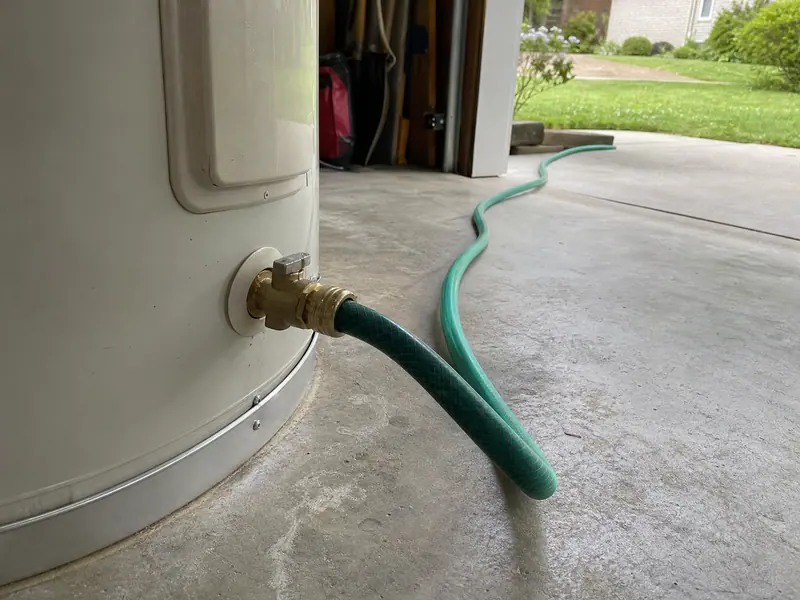
| 3 | Attach a garden hose to the drain valve; run the other end to a drain, outdoors or into buckets. |
| 4 | Turn the cold water supply valve to the heater OFF. |
| 5 | Open the drain valve. |
| 6 | Open a hot water tap so the tank drains faster. |
| 7 | Optional: inspect the anode rod, as the manual describes. |
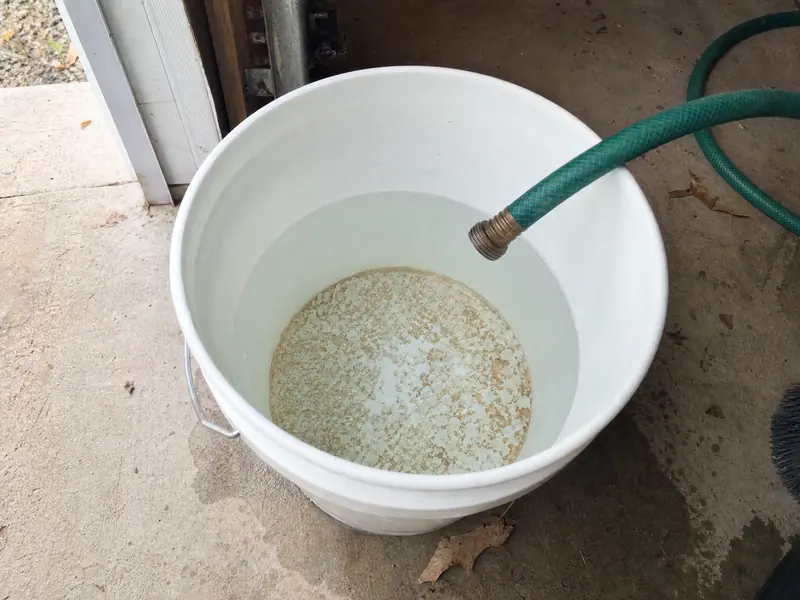
| 8 | If sediment came out, open the cold supply and let it run through until no more sediment drains, then close the drain valve. |
| 9 | Refill with the drain valve closed and a hot tap open; let hot water run full for at least three minutes, then close the tap. |
| 10 | Only now switch the breaker back on. The tank may take two hours to heat. |
Should you check the anode rod while the tank is empty?
The manual pairs the first flush with an anode check and repeats it yearly. The anode is a metal rod that corrodes in place of the tank, and the manual says a water softener makes it wear faster. Removing it means cutting away foam and using a 1 1/16-inch socket on a long extension. If that is more than you want to take on, it is a short job for a licensed plumber.
What about a gas water heater?
Draining a gas tank involves the same water side, but the gas side is off limits here. Follow your gas heater's own manual for the water steps only, leave the gas controls, pilot and burner exactly as they are, or hire a licensed plumber for the whole job. Should you smell gas, keep away from switches, phones and flames inside; step out with the door left open, and once outdoors or at a neighbor's, call 911 and then CGW's gas emergency line. A sounding carbon monoxide alarm means everyone out into fresh air, with 911 called from outside.
Rheem's video shows a short drain-off and suggests repeating it every six months, more often than the manual's yearly minimum. It also covers gas models; on a gas heater, ignore any gas step in the video and keep to the water side as your manual sets out, or call a licensed plumber.
How do you test the T&P relief valve?
The manual asks you to lift the temperature and pressure relief valve lever at least once a year, so that minerals do not seal it shut. First check where the discharge pipe ends, and make sure no one is standing in front of it, because the water comes out very hot. If water will not flow, or keeps flowing after you let go, turn the breaker off and call a licensed plumber. Never plug or cap the valve or its pipe. Have a qualified person inspect the valve every few years, as your manual states.
Is a water softener needed for a Clarksville water heater?
No. At an average of 97 mg/L, Clarksville's water is moderately hard, and a yearly flush is the manual's answer to sediment. A softener is an optional choice some households make for scale on fixtures; the manual warns that it shortens anode life. Setting the tank at 120°F also slows mineral buildup, according to the Department of Energy (DOE Energy Saver, archived copy of 22 May 2026); see the temperature page.
Behind these numbers
The steps come from one maker's electric manual (2018 revision), with Rheem's manual as a cross-check on the power warning; other brands may differ, so your own manual comes first. Hardness figures are CGW's 2025 averages of operating data, and the utility notes they vary from day to day. The manual gives two T&P inspection intervals in different places, which is why we point to your own manual's schedule. We have no figure for how much sediment a Clarksville tank collects in a year; the first six-month drain is the way to find out. The running cost page and the heater shelf cover the rest of the tank's numbers.
Questions people ask
How long does it take to flush a water heater?
The manual gives no total time. Draining depends on the tank size and how much sediment there is, and the refill needs at least three minutes of full flow at a hot tap before the power goes back on, then up to two hours to reheat.
Why must the breaker stay off until the tank is full?
The manual warns that skipping the full refill can burn out the upper heating element. It says not to restore power unless the tank is completely full, and the three-minute run at a hot tap is how you know the air is out.
Can a flush stop a water heater from leaking?
No. A flush clears sediment; it does not repair a tank. If water is coming from the tank itself, switch the breaker off, close the cold supply valve and call a licensed plumber.
What if the drain valve will not close after flushing?
Leave the cold supply off and the breaker off, catch any drips in a bucket, and have a licensed plumber look at the valve before the tank is refilled.
Should a Clarksville renter flush the water heater?
Ask the landlord first. The heater is part of the rental, and the owner may already have a maintenance schedule for it.
Sources
- Residential electric water heater manual, A. O. Smith domain · flush schedule and steps (pp.20–21), anode, T&P maintenance, softener note · checked 6 Nov 2026
- Rheem — Electric residential water heater manual AP21980 Rev 02 · power off before draining (p.22) · checked 6 Nov 2026
- Clarksville Gas & Water — Water Quality Report page · 2025 hardness average and range · checked 6 Nov 2026
- USGS Water Science School — Hardness of Water · hardness classes · checked 6 Nov 2026
- DOE Energy Saver — Lower Water Heating Temperature, archived copy of 22 May 2026 · 120°F slows mineral buildup · checked 6 Nov 2026
- Rheem Water Heating — How to Flush a Tank Water Heater (video) · drain-off demonstration · checked 6 Nov 2026